
Outreach Playbook For Summer EBT Resources
If you are an agency administrator looking to use any of the materials or tools featured in this playbook, please reach out via this form. We’re happy to help customize materials, discuss partnership strategies, and answer technical questions.
Summer EBT, also known as SUN Bucks*, provides grocery benefits during the summer to families with children in school. As a relatively new federal nutrition program, Summer EBT presents new and exciting opportunities, both to ensure families and children have summer food resources, and to approach food benefit access in new and innovative ways.
Agencies** have implemented Summer EBT as a federal program for two years, and we’ve already seen tremendous evolution of the program!
**For brevity purposes, the playbook uses 'agency' to mean Summer EBT administering agencies and 'state' to refer collectively to states, territories, and tribes that operate the program.
Coordinating and partnering agency staff have done heroic work to stand up a complicated program quickly and get benefits out to millions of children while balancing limited capacity and an evolving social safety net with a stream of constant changes. And we know that in all the intense timelines and back-end systems needs, sometimes outreach and communications doesn’t get as much capacity as an agency may desire.
We at Share Our Strength, No Kid Hungry care deeply about Summer EBT because it helps close the long, persistent summer hunger gap for children, along with the new, exciting changes to summer meals. That’s why we’ve been working closely to support implementation and ensure the program's success. In summer 2025, we worked alongside state agencies, statewide partners, and school districts in five states (Arkansas, Arizona, Kentucky, Michigan, and Nebraska) to conduct Summer EBT communications and outreach pilots that focused on increasing simplified messages and engaging key stakeholders to conduct outreach. The work of these pilots informs this playbook and grounds our recommendations and resources. Partnerships with Code for America, supporting states with technology and data projects and key communications efforts that complement these efforts, and APHSA, through the Summer EBT Community of Practice, also inform and feature in this playbook.
Summer EBT is a complicated program to explain which is also compounded by a general lack of awareness of the program as it’s new. These difficulties impact families and agencies, greatly increasing customer service burden and requiring a lot of hands on staff time. This playbook, and the included resources and tools, are intended to reduce the burden on agencies and families in communicating about the program and understanding it.
There are great materials available for SUN program awareness, including Summer EBT/SUN Bucks, which this playbook is not looking to replace. Instead, we saw a gap in materials, messaging, and strategies that helped ensure families understood Summer EBT program eligibility, knew if they needed to take any action to receive the program, and to reduce confusion about the overall process.
Summer EBT can be confusing to families, especially because of the dual paths to benefit receipt (with many children receiving the benefit automatically and some needing to apply). Differences in issuance and program operations across states can also increase confusion. Families may not understand who administers the program, how their children qualify, how and when benefits show up, and how to resolve questions about the program. What we’ve generally seen throughout the two years of implementation is that frequently families, as well as community partners who support them, don’t understand this nuance and who can blame them! We’ve tested strategies, messaging, materials, and tools that will help provide clarity for families without overwhelming them. We provide guidance on a timeline for communicating key information, taking advantage of the cyclical nature of the program as well as tools and materials that pair well with these suggested pushes.
We know agencies have more desires for outreach and communications than they have time or resources to devote to it. Our goal is for this playbook to be a one-stop shop for Summer EBT outreach - providing customizable materials agencies can use and effective outreach strategies to get the most out of limited time and capacity. From our work with states, schools and community partners, it’s clear that there are many key partners in communities, especially schools, who are willing and enthusiastic about sharing Summer EBT information and ensuring their families have this additional resource. These partners need clear direction, effective messages, and low-lift strategies from their Summer EBT administering agency to make sure what they share with families is accurate, and that they can answer key basic questions, in order to in turn reduce the need for families to connect with agency customer service resources.
Standing up Summer EBT over the past two years has taken a huge amount of effort from agencies, while they are also facing enormous pressure and challenges to ensure the safety net is available for their communities. As Summer EBT matures, we believe that the program will not require a large ongoing staff need, and that it can be sustained efficiently by agencies. Through the tools, materials, and messaging in this playbook we hope to help build towards a sustainable Summer EBT program by reducing the burden on agencies and families, allowing for this program to be an expected, regular summer support that families anticipate and agencies feel they can sustainably operate.

As Summer EBT matures, we believe that the program will not require a large ongoing staff need, and that it can be sustained efficiently by agencies. Through the tools, materials, and messaging in this playbook we hope to help build towards a sustainable Summer EBT program by reducing the burden on agencies and families, allowing for this program to be an expected, regular summer support that families anticipate and agencies feel they can sustainably operate.
The playbook features multiple sections that build on each other, but can also be used to meet particular outreach needs. The main location to find the materials, messaging, and guidance for Summer EBT outreach is in the section titled ‘Communicating about Summer EBT.’ A critical part of Summer EBT outreach and communications is ensuring consistent, concise, and clear messaging across materials. This section grounds in that goal and is the place to go when you have limited time and want clear takeaways on the key messages, materials, and approaches that can be used across all partners and audiences.
Other sections provide guidance on leveraging technology that features an easy-to-adapt Summer EBT eligibility and income screener, partnering with schools that highlights practical examples of partnership to support Summer EBT awareness, agency communications that provides examples of notification and webpage updates for clarity, and strategic community partnerships showcasing ways partners can enhance agency outreach efforts.
The outreach materials and tools, like the eligibility screener, are built for customization. We’ve created messages to use at key times and simplified materials, but built a structure for agencies to customize with critical program information that is dependent on the decisions their state/territory or Tribe has chosen for administering the program.
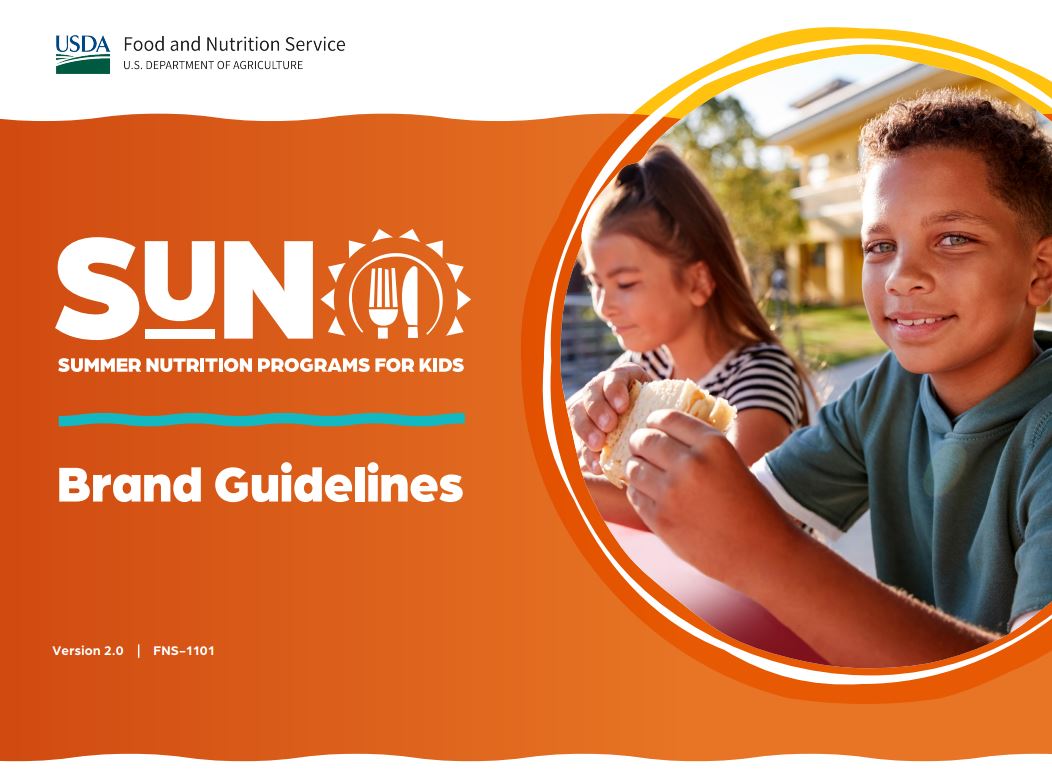
*Note that the template resources that we’ve created align with the USDA’s SUN Programs Branding Guidelines, including logo specifications, brand colors and fonts (These materials use the Montserrat font.), for agencies looking to align with those guidelines
We are confident in the materials, messages, and approaches outlined in this playbook. They’re based on real-world examples from summers 2024 and 2025 and done in partnership with experienced UX and visual designers grounded in message testing and feedback from community, school, and parent/caregiver stakeholders in English and Spanish. And we also see this playbook as a living document that we plan to continue to update as Summer EBT continues to evolve. We anticipate adding in new information, examples, and sections moving forward within 2026 and in future years as we evolve our work, learn from new opportunities, and hear from agencies, partners, and families on effective outreach and communications.
Are you a Summer EBT Administrator? We want to hear from you!
This section describes the general approach to messaging around Summer EBT and SUN Bucks that we are offering in this playbook. We strive to include concrete, actionable suggestions on what to include and what to avoid, which are echoed in other sections of this playbook. These suggestions are grounded in what we heard from families, partners like schools and community-based organizations, and agencies, coming out of summer 2025. At the end of this section, we include template resources (flyers, social media posts etc.) for Summer EBT outreach, for those who are interested in customizing materials with information specific to your state/territory/tribe. And if you are developing language for materials you are designing, we hope you will incorporate the principles and language suggested in this section into your resources.
Investing a small amount of resources in raising awareness, and providing others with easy ways to do so, can improve program participation while also reducing the customer service burden for your agencies.
Need help with customizing outreach materials?
Awareness of this still-new federal nutrition program is growing, with room for improvement.
As more families become aware of the program, they are interested in understanding basic program information. In a parent survey conducted in fall 2025, the most-sought out information on Summer EBT was how and when benefits are issued (56%), who is eligible for the program (46%) and how to apply for or enroll in the program (38%). Family-facing communications that include clear information on these topics can help to build trust in Summer EBT.
On the most basic level, the benefit amount is a source of confusion and frustration, while also presenting an important opportunity for program recognition and awareness. Language that led to the misconception that Summer EBT was $120/month, rather than $120/summer, contributed to frustration and disappointment.
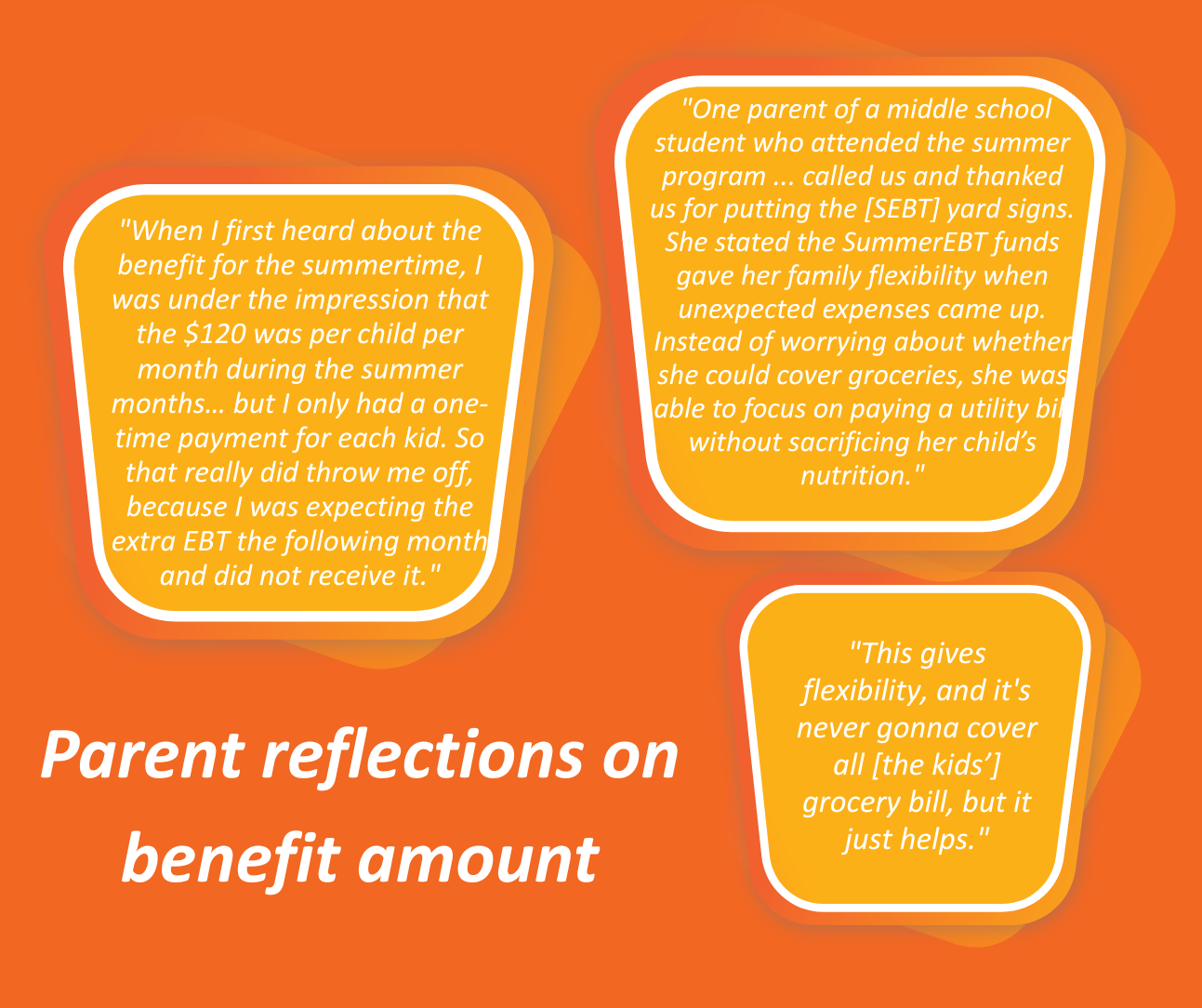
With a clear expectation of the amount, families highlighted the breathing room this provided during challenging summer months, and their gratitude for the program. While the dollar amount may be small, relatively-speaking, if Summer EBT is a reliable source of support going into each summer, it will be a trusted and appreciated resource for many families. Being clear and upfront about the benefit amount can help build trust and awareness, including for those who are issued benefits on existing EBT cards.
State-specific and accurate information is critical to building trust in the program. Variation in how states are implementing the program makes it difficult to provide families with actionable information on a national level, and can lead to unnecessary confusion. Therefore, we have created materials that can be easily customized with state-specific information, and urge you to share messaging and materials that are specific to and accurate for your agency. In particular, information on programs used for automatic program issuance, who may be eligible by application, and how benefits are being issued should be state-specific. (Our template resources align with the USDA’s SUN Programs Branding Guidelines, including logo specifications, brand colors and fonts, for agencies looking to align with those guidelines.)
If you are reading this playbook, you already know that Summer EBT presents a fantastic opportunity to support children in the summertime. However, the reality is that the regulations around the program, especially related to eligibility, can be very confusing. It is incumbent upon us to simplify this message, to ensure that eligible families have access to Summer EBT. We recommend that you use the combination of clear, consistent language, and tools like eligibility checkers described in the Leveraging Technology section, to reduce this potential confusion and ensure families can easily understand key information about the program.
What does this mean in practice?
Use plain language to make your messages clear, accessible, and actionable for the widest possible audience. Be concise, use the active voice, and organize Summer EBT information in sections or lists so that it is easy to digest. By removing jargon and technical terms, plain language ensures information is easier to understand, especially for people with varying literacy levels or those new to using food assistance benefits. Clear communication also signals transparency, helping people feel that the information is intended for them. As a result, families are less likely to misunderstand program requirements or feel confused, enabling them to take the right steps to access benefits.
Identify clear and consistent ways of talking about the program and its core concepts, including who is eligible and the benefit amount, so that any resources or information that is shared (i.e. state agency website, outreach materials, media engagement, as well as through any community partners) use this same language (see “Key Messages for Summer EBT/SUN Bucks” below). It is incumbent upon us to simplify these messages, in order to ensure that eligible children have access to the program

Avoid using terms or language that are unfamiliar or confusing to families. For example, avoid referencing NSLP, SBP, CEP, FPL, and language like “streamline-certified” or “direct certified” in family-facing materials. A parent or guardian is unlikely to know whether their school participates in NSLP/SBP or CEP. Similarly, while a family can answer a question about their weekly or monthly household income, referencing 185% of the federal poverty level is unlikely to be meaningful or actionable to them.
One of the most consistent pieces of feedback we received on Summer EBT in 2025 was to share information on the program earlier in the school year. We recognize that the POM approval timeline and other aspects of the program outside of agencies’ control can make it challenging to communicate full details early in the school year. Our recommendation is to prepare materials as you are awaiting approval, and develop a communication plan that alerts key groups ahead of time to what will be coming (i.e. “SUN Bucks will be back for summer 2026, and we will share more details at a training on April 10”), while acknowledging what remains uncertain (i.e., “benefits will be issued to children receiving Summer EBT automatically between May and July, and we will provide more detailed information on our Summer EBT website when it is available”).
Many reported that a timeline to guide which messages to share when was very useful for getting the word out in their community. We have built out that timeline, and suggested key messages for different moments, which you can modify based on the specific details for your agencies – for example, when most schools have spring break, when school wraps up for the year, and when back-to-school communications begin. Below is an example of a Summer EBT communications timeline.
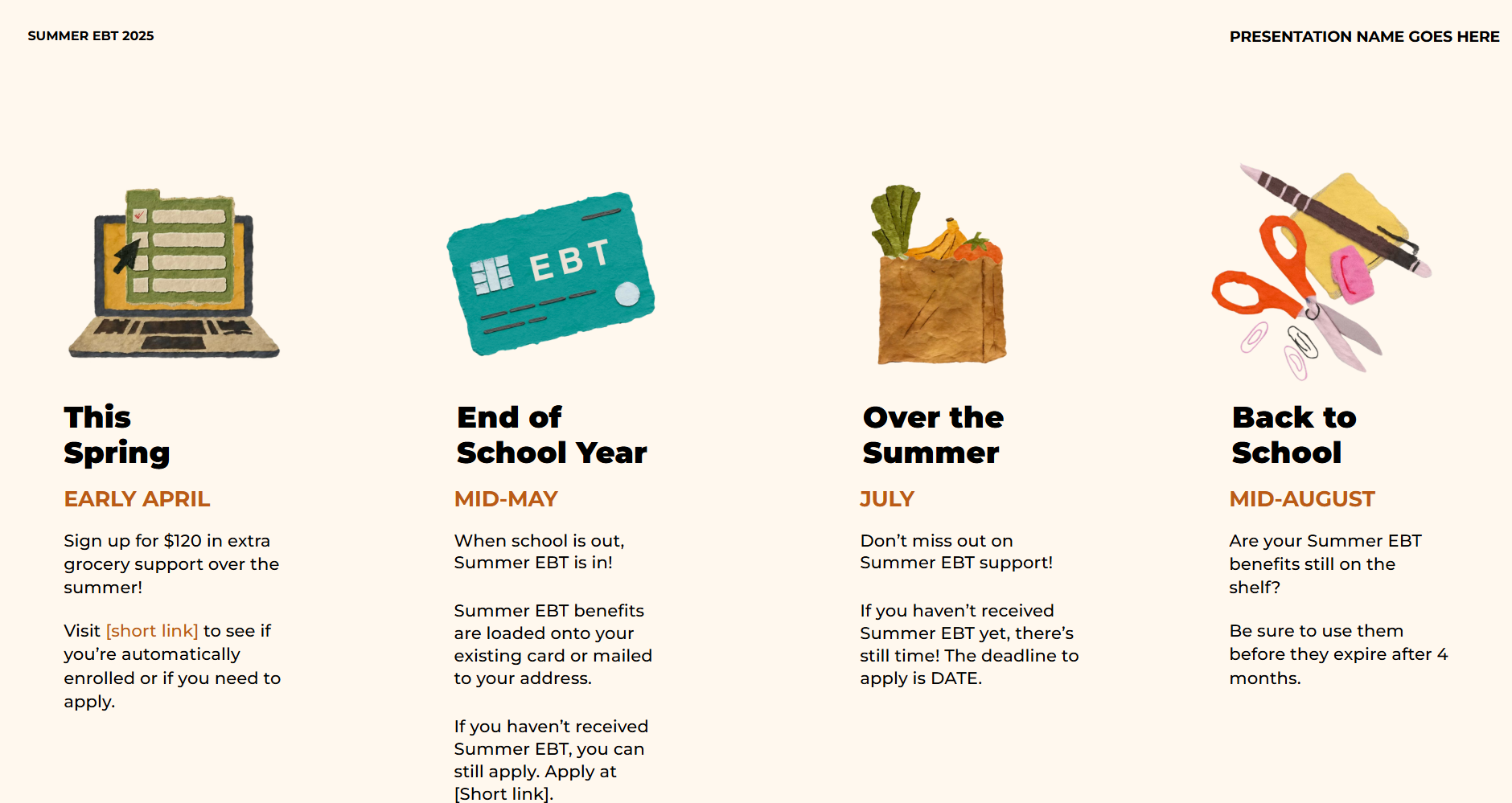
Communications Timeline
This timeline leverages specific moments in the school calendar, to draw attention to actions that may be required of families eligible for or enrolled in the program.
“We were able to get information out to our school sites before the end of the school year which really helped. I think that if Districts are given more information prior to the start of SUN Bucks 2026, that these efforts on our part could be much improved.”School Staff
- on 2025 SUN Bucks efforts
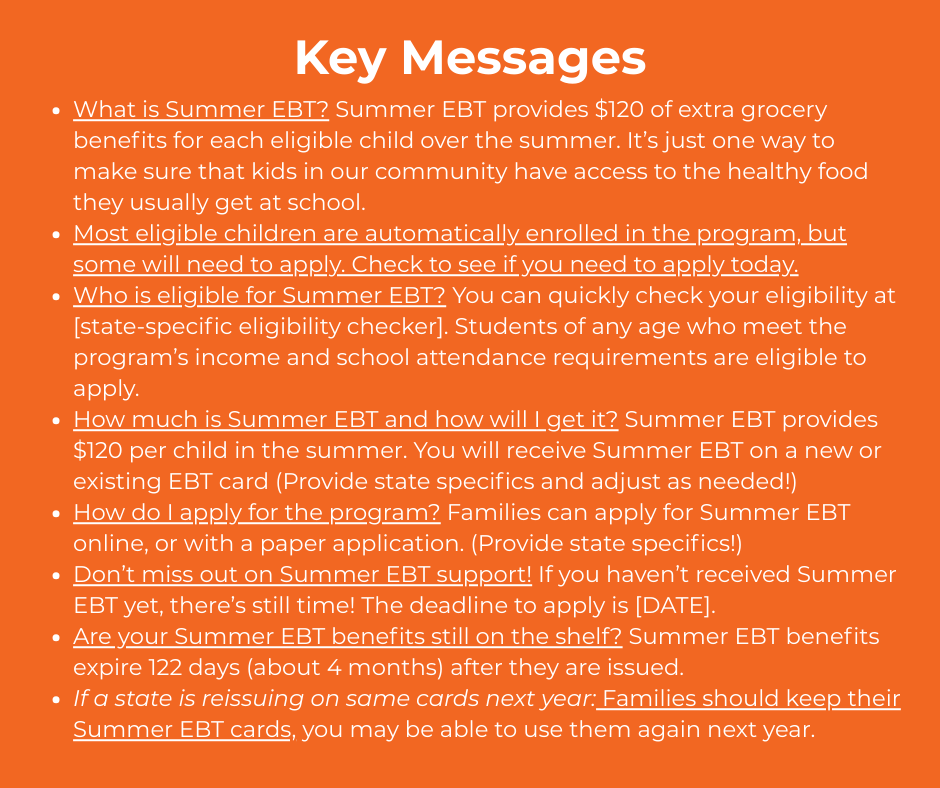
The following messages were developed to reflect feedback from families, schools, CBO partners and agencies, and the recommendations described above. These messages can be found in the template resources below, and we encourage you to use these key messages, and answer these key questions, on your Summer EBT websites and in other Summer EBT communications. They provide the key information families want to know about the program, and provide them with clear calls to action.
Note that the template resources that we’ve created align with the USDA’s SUN Programs Branding Guidelines, including logo specifications, brand colors and fonts, for agencies looking to align with those guidelines. (These materials use the Montserrat font.)
Coming soon: text for school newsletter, messaging app, or website.
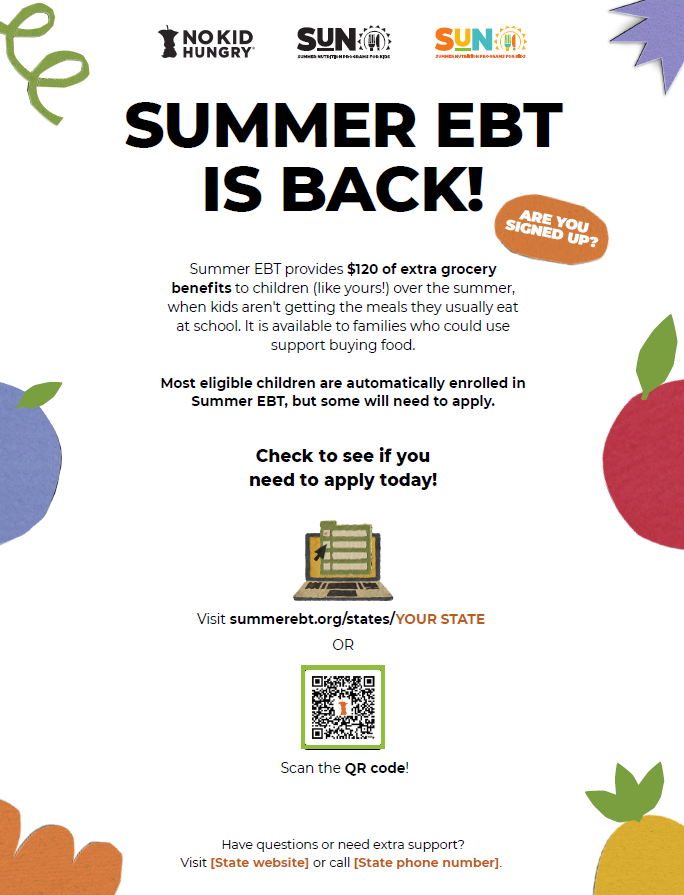
Family Flyer
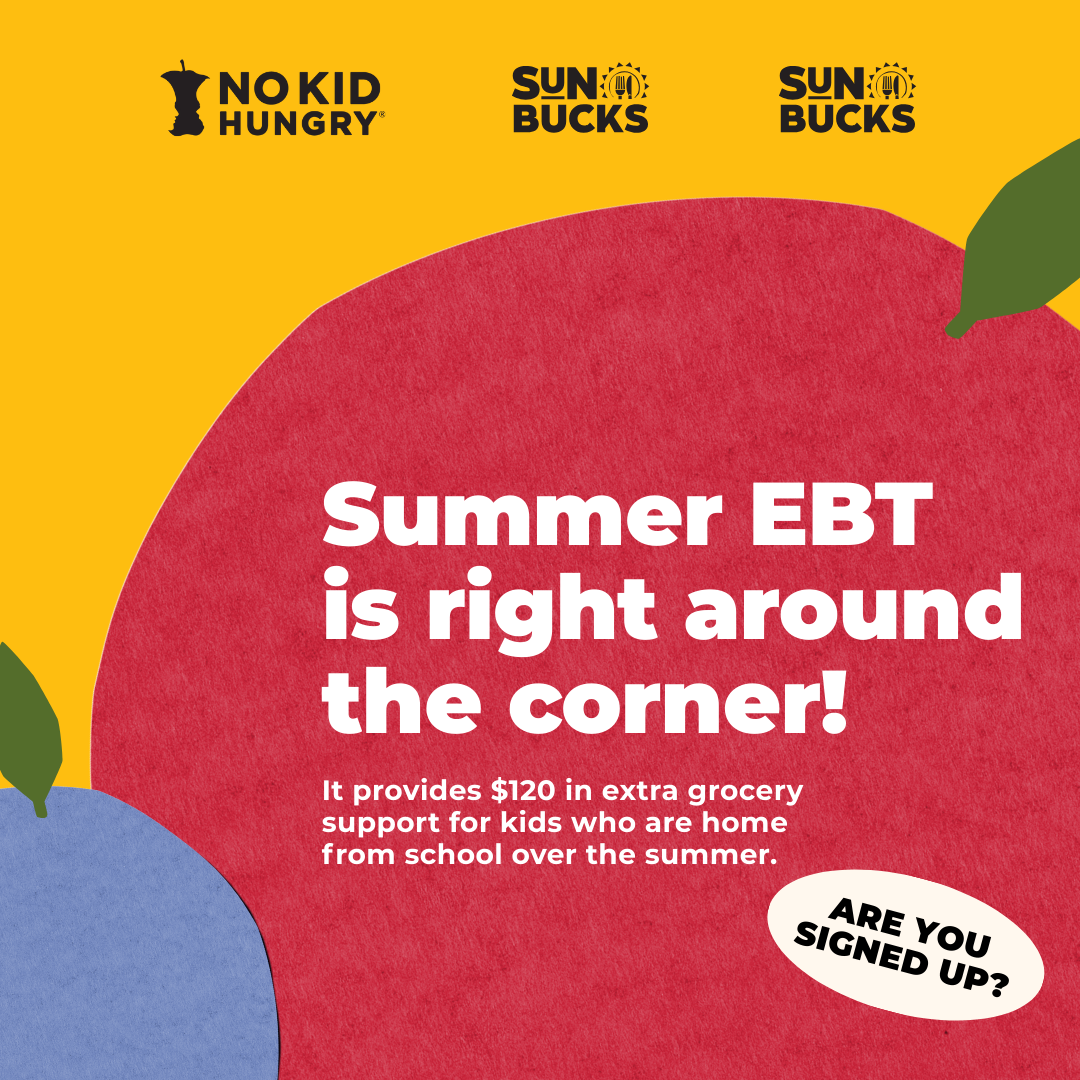
Social Media Images
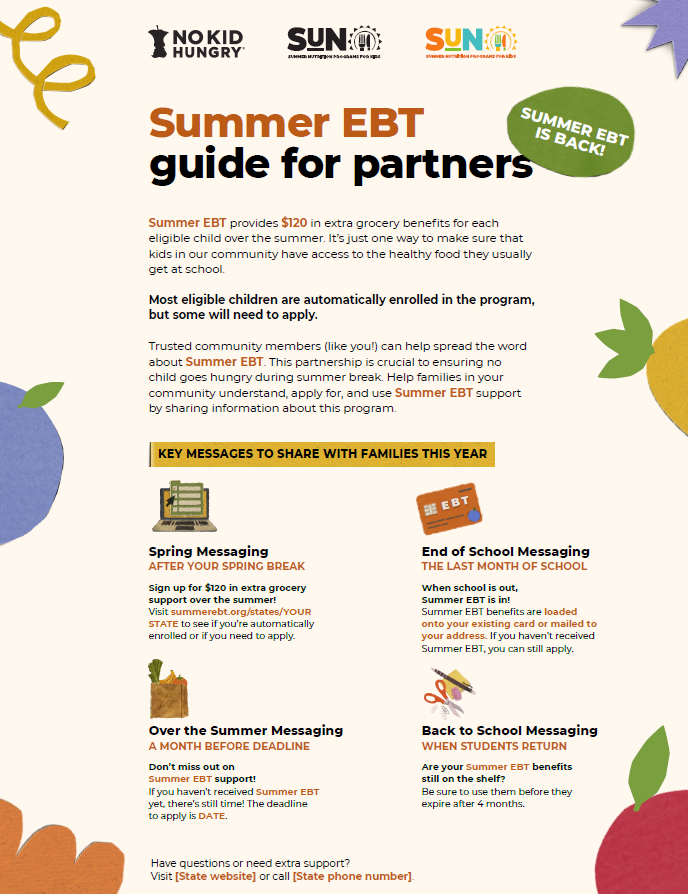
Summer EBT Guide for Partners
Need help with customizing outreach materials?
If you are an agency administrator looking to use any of the materials or tools featured in this playbook, please reach out via the form linked below. We’re happy to help customize materials, discuss partnership strategies, and answer technical questions.
Other customizable tools, resources and examples coming soon or linked below.
- A PowerPoint slide deck for a Summer EBT training webinar. Customized with specific information for your agency, this can provide the basis for a brief, 30-minute webinar for school staff and community advocates. It will cover program basics and responses to frequently asked questions, and share easy ways to get the word out in a community.
- Example: webpage for hosting Summer EBT outreach materials: https://state.nokidhungry.org/kentucky/summer-ebt/ This is an example, from Summer 2025, of Summer EBT outreach materials available for school staff. Staff were able to select the ready-to-use, state-specific resources (both designed materials as well as text that could be copy-and-pasted) most appropriate for use in their community.
This section provides examples and suggestions for agency Summer EBT communications directly to families including mailed notifications, the agency’s Summer EBT webpage, and electronic notifications (texting & email).
Agencies are the source of truth regarding the Summer EBT program for families, schools, and community partners. The official information and communications from the agency is where families and partners confirm what they’ve heard about Summer EBT. Given this, it’s important any communications from the agency be in plain, simplified language ensuring readability and focus on key calls to action.
The examples and guidance highlighted in this section primarily reflect the work of Code for America from their specific Summer EBT agency collaborations or their best practices learned through many years of partnership with human service agencies.
Code for America partnered with the state of Arizona to redesign its notices for Summer 2025. Many individuals learn about Summer EBT through the notices that they receive, meaning that it’s essential for states to provide clear, non-bureaucratic instructions to families while also following policy and legal guidelines. To learn more about what makes a good notice, read Code for America’s guide here, and to take a look at Arizona’s redesigned notices, check out this link.
Use these tools as a guidepost to update your own Summer EBT notices alongside relevant vendors, like your agency’s printer and tech vendors.
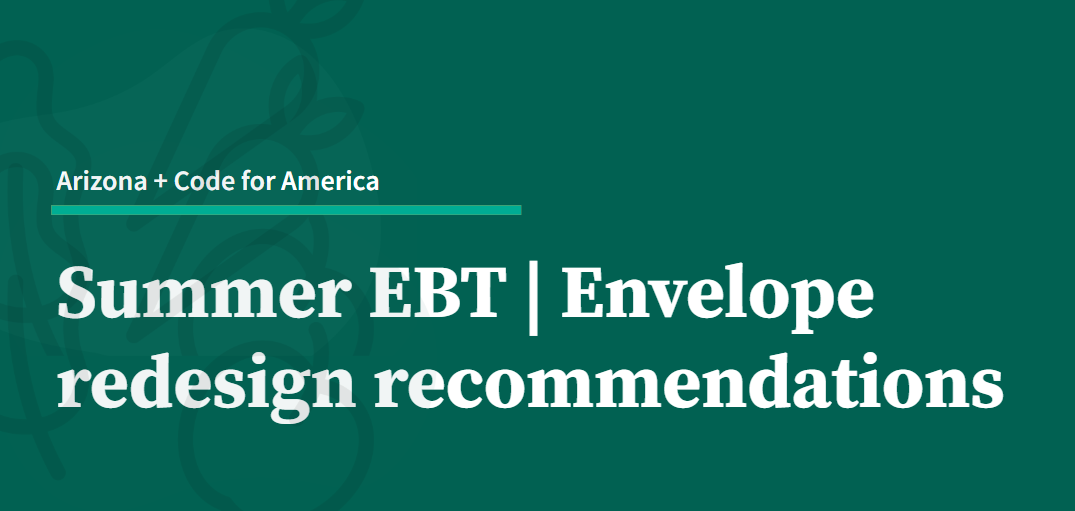
Code for America drafted a redesign of Arizona’s envelope notices to further indicate to families the importance of the mail they were receiving, so families don’t accidentally throw away mail addressed to their child.
The agency’s Summer EBT website is the landing page where families and partners will go when searching for more information about the program. In a parent survey conducted in fall 2025, 61% of respondents cited a website managed by state government as helpful for getting more information on Summer EBT, making it the second most helpful tool for families after an eligibility checker.
Check out the Leveraging Technology section of the playbook to learn how Share Our Strength’s free, customizable eligibility checker tool can support your outreach efforts!
The Summer EBT webpage offers a place where key program information can be expanded that wouldn’t otherwise fit on a flyer, such as providing more in-depth FAQs. However, it’s important to ensure the announcements, key information, and links (like to an eligibility checker and the application) are clear to those visiting the webpage. Webpages provide an opportunity for transparency and allow real-time updates and announcements as program operation details– such as planned issuance dates or unexpected delays–become available.
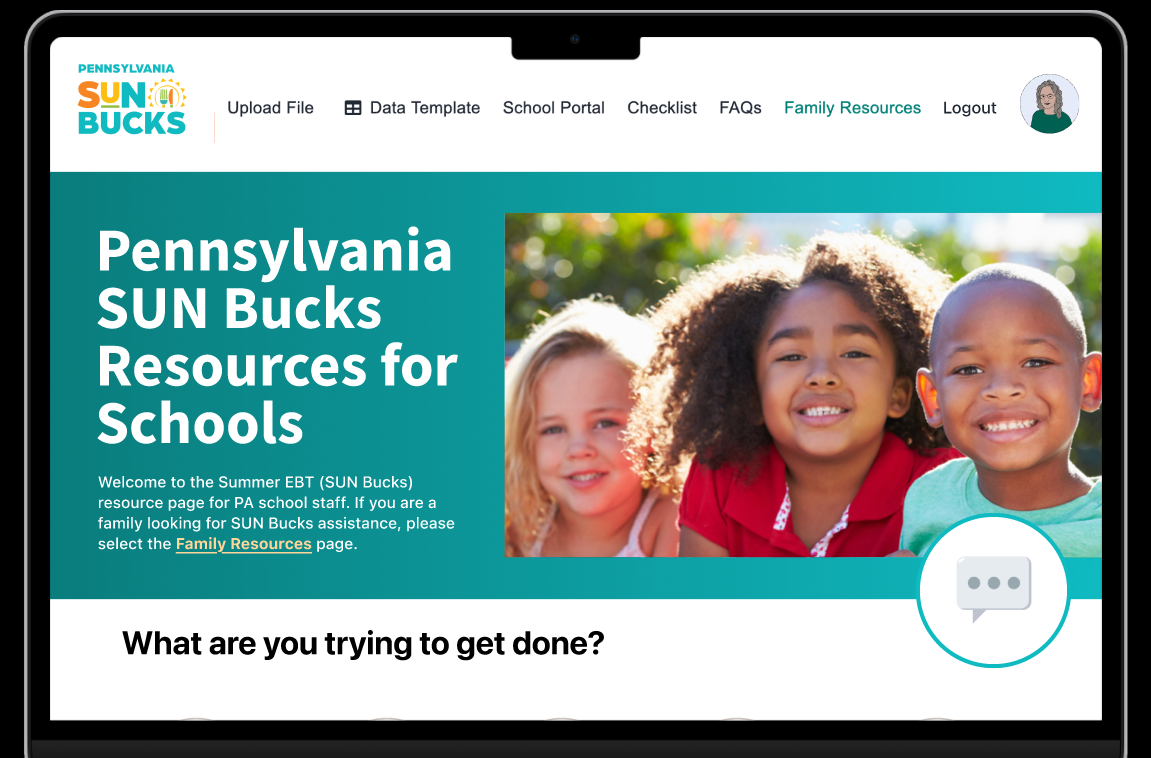
Linked below you can see a streamlined version of a prototype of an existing landing page for school and nutrition staff in Pennsylvania. The landing page outlines clearly important dates, FAQs, and essential links for partners submitting school data to PA’s vendor.
In our main template materials, we provide recommended FAQs that answer families’ and partners’ key questions about Summer EBT. We also recommend these be included on a Summer EBT webpage along with other FAQs that may be important to your context.
Coming soon! We will provide expanded customizable FAQs we recommend including on a Summer EBT webpage. We encourage agencies to include FAQs directly on your website (ideally as an accordion), which helps search engines, like Google, to read and understand the content and rank it higher in search results (text included in a PDF or linked document hosted off the webpage will not be scanned by a search engine). This can help families find answers faster and more easily while also allowing for FAQs to be updated as needed.
As with many safety net and child nutrition programs, texting and email can be a great tool for agencies to send reminders to families about Summer EBT enrollment, drive them to eligibility checkers and self-service portals, and flag expungement dates.
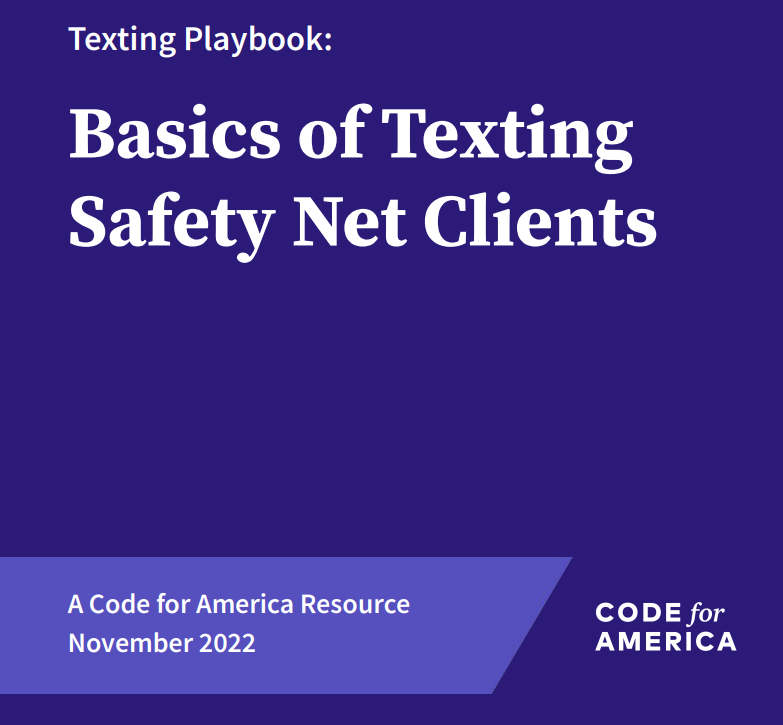
Code for America put together a Texting Playbook to help agencies develop human-centered texting plans. The playbook is informed by CfA’s experience partnering with agencies to send SMS text messages. The Playbook provides guidance and well-researched strategies to help state agencies implement texting in support of Medicaid, SNAP, WIC, and other benefits programs
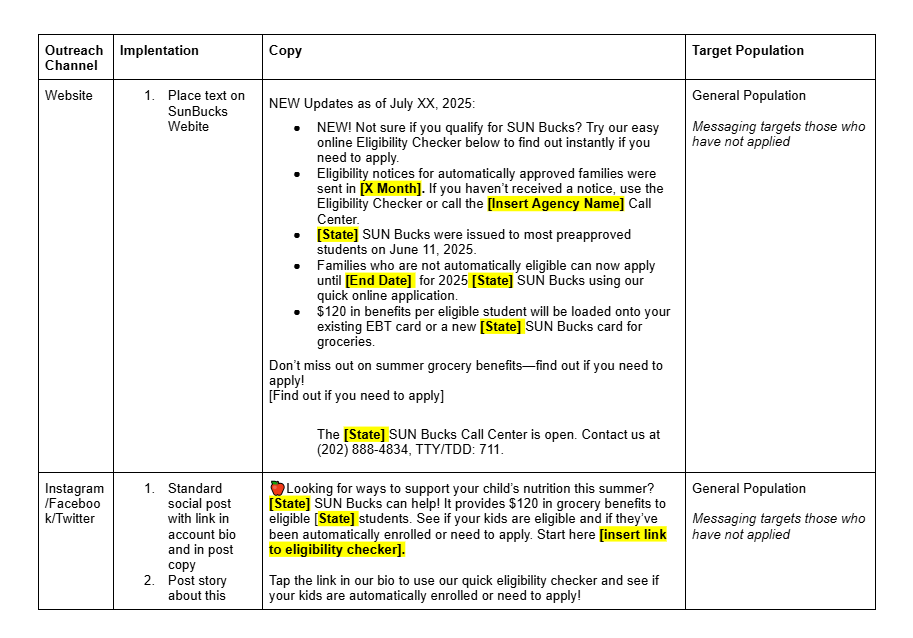
Code for America has a demo tool around texting for safety net benefits that agencies can view, including scripts and GitHub code that agencies can download. Code for America conducted social media outreach and texting with a partner to promote a new enrollment screener with clients. Use these tools to get started texting clients, find examples of the types of messages to send, source Federal Communications Commission (FCC) policy guidance, how to encourage opt-ins and collect consent to text, and how to avoid coming across as spam.
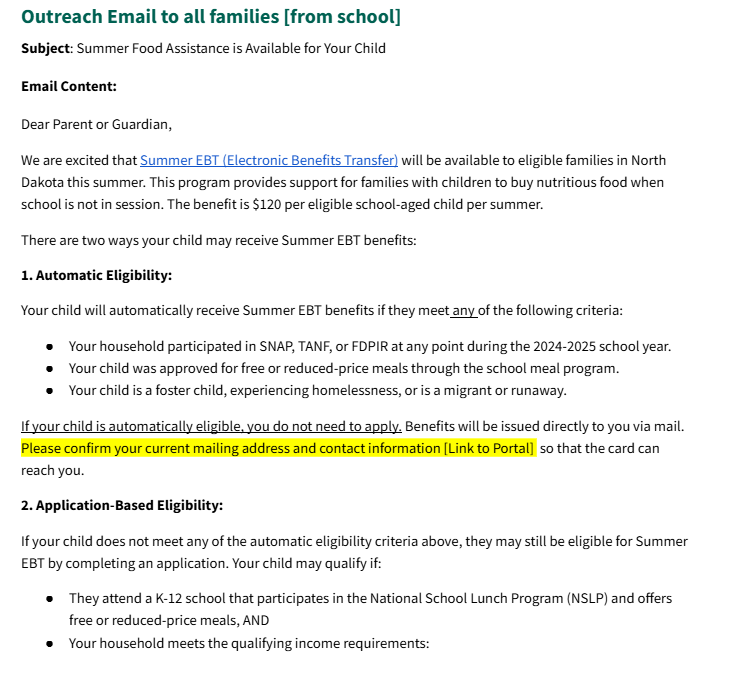
Code for America assisted several states in developing outreach and communication direct to family communications in 2024 and 2025. We have an example of personalized emails created for North Dakota in 2025. Note that the tools here are written for the North Dakota context and should be modified for your state context.
Effectively incorporating technology into outreach and communication in the ways described below can simplify program information and make it more accessible to families and other stakeholders. It can empower families in a human-centered way, allowing them to navigate and take action related to Summer EBT, without requiring them to understand policy nuances. It also empowers schools and community partners, allowing them to share key program information without requiring them to answer every eligibility question themselves. Many key trusted messengers for families, like school stakeholders, will engage in awareness raising if the lift isn’t onerous, and technology tools like an eligibility checker can simultaneously make awareness-raising easier while decreasing families’ reliance on these stakeholders to explain eligibility.
This section of the playbook highlights how technology can be used within and alongside Summer EBT communications to make the program more accessible for eligible families, and ensure a human-centered Summer EBT experience.
In particular, technology can help to significantly ease confusion around program eligibility, which otherwise creates barriers to the program and complicates program communications. For example, we’ve seen many states create or otherwise direct families towards an eligibility checker or screener. Intentional use of family-facing technology such as an eligibility checker can add to overall outreach capacity and ease customer service burden for both families and agencies.
Last year I’d reply to 130 emails and still have another 130 to get back to in a day... This year, throughout the year, I was [ready for more work]. The more people involved, getting it out, with the [eligibility] checker seeing first hand -- they could see the requirements instead of waiting for me to get back to them with the eligibility information.Anonymous
- Agency Staff
- Department of Education
Eligibility checkers or screeners are a cornerstone technology resource and tool states can use in outreach and communications to support families in navigating summer EBT.
There are multiple versions of Summer EBT eligibility checkers, with different levels of specificity and certainty. The ideal version (highest level of child specificity and certainty) involves connecting to backend systems to confirm if an individual child is already automatically eligible for Summer EBT (found within the streamlined certified data). Examples of this include an eligibility checker in Illinois, and Code for America has suggestions on eligibility screeners within their best practices for Summer EBT self-service portals. Code for America and DC DHS also created an enrollment checker last summer that will be updated for Summer 2026.
While not every Summer EBT administering agency has the capacity or system to create an eligibility checker that can incorporate backend child-specific data from their Summer EBT database, there are still effective and lower tech ways to provide an eligibility screener that helps families navigate eligibility for their specific situation. For example, Summerebt.org represents a great, generalized eligibility checker and many states have created their own versions of this or link to it directly on their website.
Another version provides specific information on the school level, without linking to individual-level data on the backend. We developed three eligibility checkers like this in Kentucky, Michigan, and Nebraska for summer 2025 outreach and communications efforts, in partnership with state agencies and statewide partners.
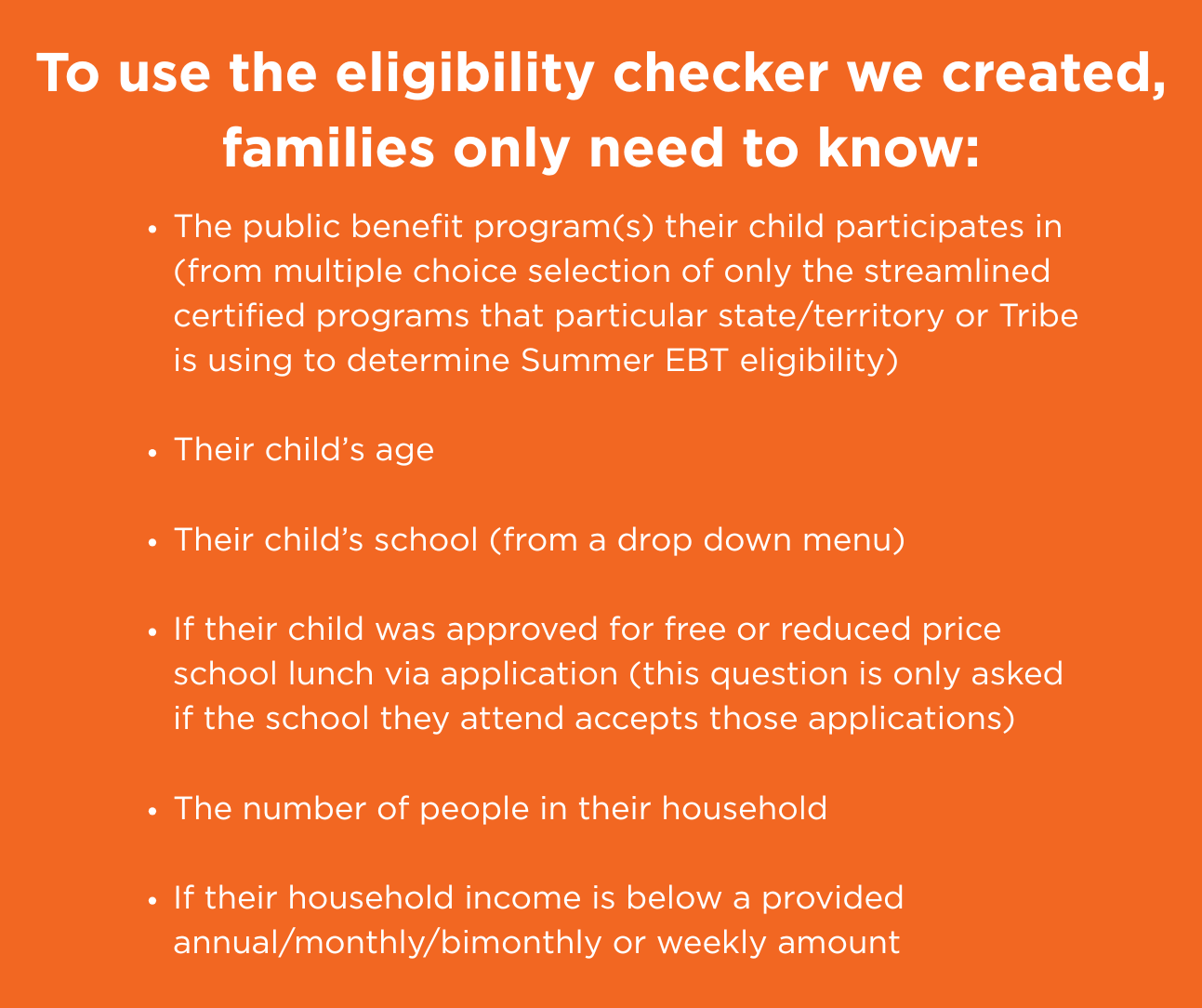
We designed these eligibility checkers to aid in outreach and allow for simple messages with a call to action for families - check your eligibility and, if needed, apply for Summer EBT. These eligibility checkers represent an option between backend data matching and a more generalized checker, as we incorporated state-specific information including schools’ National School Lunch Program or School Breakfast Program (NSLP or SBP) and Provisional status (Community Eligibility Provision or Provision 2).
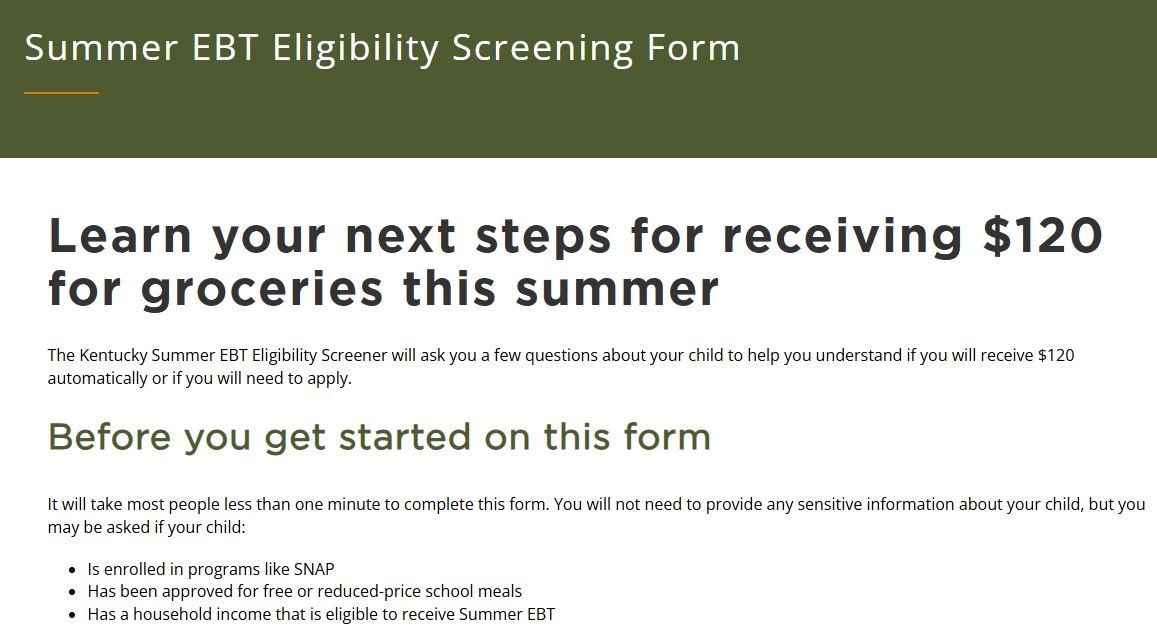
Here’s an example of the eligibility screener from Kentucky!
In one state where we supported an eligibility screener, they had a 152% increase in applications from 2024 to 2025 (from 3,116 to 7,857 applications), while seeing a consistent 40% of applications approved from one year to the next and a drop from 46% to 23% of applications denied from 2024 to 2025 (the difference was a larger percent of incomplete applications in 2025).
In another state where we created an eligibility screener, the number of children who received Summer EBT via application doubled from 2024 to 2025 (~9,000 to 18,479), with a large increase in applications from one year to the next. In this state, the eligibility screener saw significant traffic, with 38,718 website views over the course of May - August 2025.
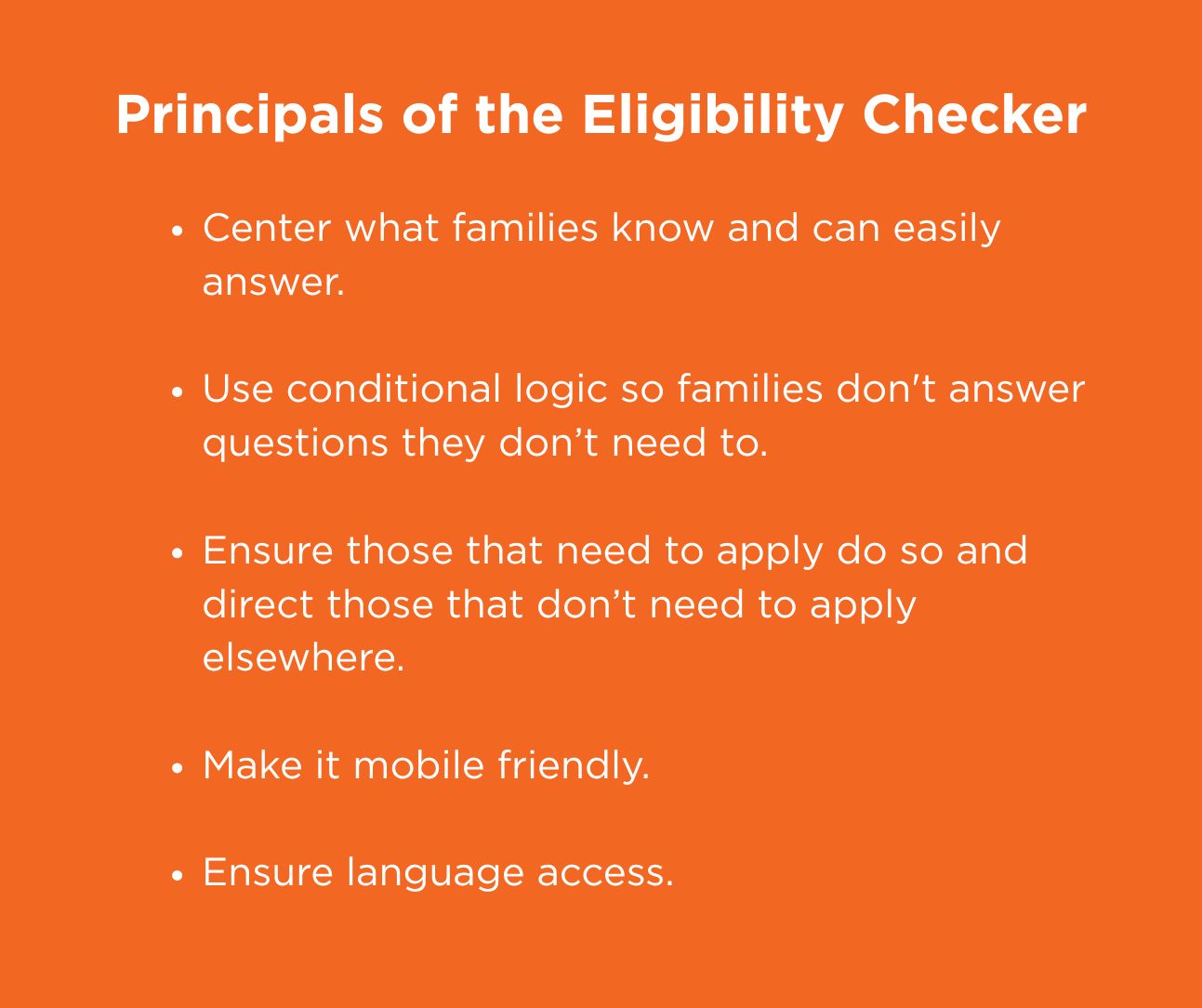
We’ve updated the eligibility checker for 2026 (linked here is a mock version) and provided the code and process for any agency to use and adapt it to their state, territory or tribal community, for use in your outreach and communications efforts. See the customizable resources & tools for information on how to receive the eligibility checker.
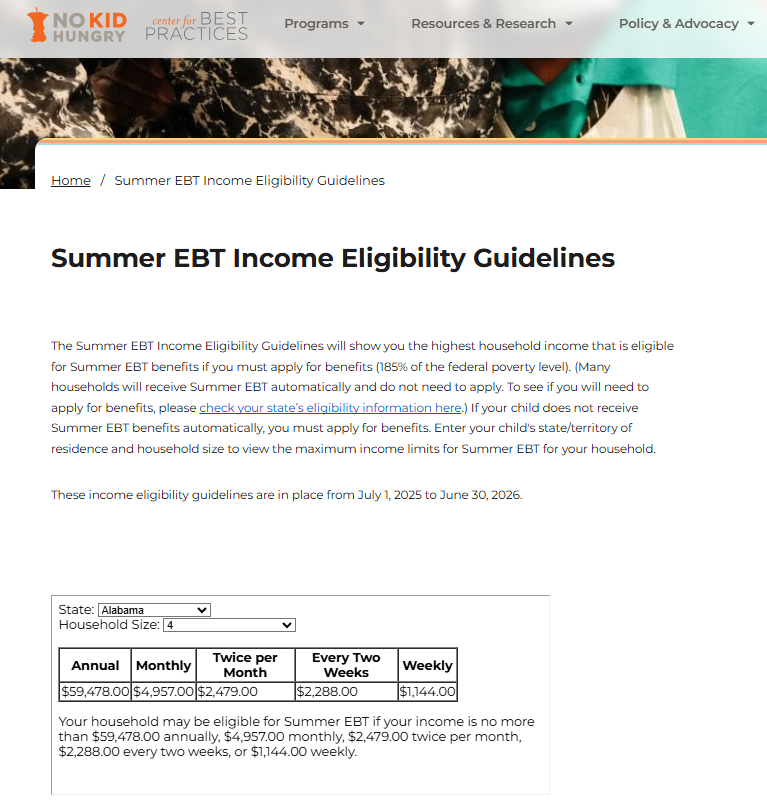
Providing Summer EBT income guidelines provides transparency and actionable information for households that need to apply.
No Kid Hungry created a basic income eligibility guidelines tool that provide annual/monthly/twice per month/two weeks/weekly income thresholds by household size in each state to help families know their income eligibility for Summer EBT. This information is available as a standalone resource, and is incorporated into the above eligibility checker.
See the customizable resources & tools section for the code and process to add this resource to your website.
The Summer EBT application is a great place to leverage technology to ease the burden on families and agency staff. In the first two years of the federal program, we’ve generally seen low application submissions and approvals. This primarily represents confusion about how to qualify for the program and that some children may be eligible by application only, which we believe can be addressed with the outreach solutions outlined in this playbook. But the application itself can also aid in increasing accurate submissions and make it easier for agencies to process.
It’s important to ensure the Summer EBT application is easy to find. When links to an application are not clearly accessible to someone searching online, or are available only behind a screener that some families may struggle to work through, families are simply not able to apply for Summer EBT. Applications should not be a barrier to program access. We recommend promoting an eligibility checker alongside an application, actively encouraging families to use the checker to know if they need to apply, without hiding the application. We also recommend providing PDFs of the application that can easily be found and submitted via email or mail, with clear instructions on how to do so. School staff and advocates across the country consistently express concerns about a small subset of families that face barriers to accessing and completing online applications, and request clear access to paper applications for this population.
Analyzing application submissions for common barriers and denial reasons can help identify easy, low-cost fixes to increase application accuracy and approvals. Are there a lot of denials that are happening because a key field isn’t required (like a signature) so applicants are missing this before they submit? Small changes like making questions required or incorporating automatic verification of things like addresses (such as confirming if a mailing address is a known USPS address before it can be accepted) can increase accurate, complete submission.
Code for America partnered with multiple states to develop an outline of what a user-centered application for Summer EBT could look like. Using human-centered design principles outlined in its Benefits Playbook and expert knowledge from the Summer EBT playbook, CfA put together Figma files for what an application experience could look like.
Eligibility Checker:
- The eligibility checker is available for you to use! We’ve adapted the eligibility checker we created for summer 2025, to allow any agency to use it for 2026. It’s customizable to adapt to program specifics in your state, Tribe or territory and is created with code so you can easily add it to your Summer EBT website.
- To customize the eligibility checker for your state, Tribe, or territory, you will enter your Summer EBT program-specific information into the spreadsheet and then click a button to generate a webpage containing the customized eligibility checker.
- To generate the customized eligibility checker, you must be able to run Excel macros. Macros contain code that help Excel automate certain activities, such as the creation of the HTML file. Learn more about enabling macros here.
- Fill out this form to receive the eligibility checker. We’re happy to support you with adoption of this tool and any troubleshooting.
Income Guidelines Tool:
- The income guidelines tool is available for you to use. You can adapt the income guidelines to your state/territory/Tribe and incorporate it into your Summer EBT website.
- Fill out this form to receive the income guidelines tool. We’re happy to support you with adoption of this tool and any troubleshooting.
Application Guide:
- Code for America put together Figma files for what a Summer EBT application experience could look like.
- How to Use: Share the Figma files with your tech and design teams to map to backend systems. Be sure to review and update the files for your state’s specific context!
In this section, we discuss the value of partnering with schools to spread the word about Summer EBT, as well as specific strategies for doing so. This is based directly on our efforts partnering with states and learning from school and agency experiences in summers 2024 and 2025. This section relies on the following core principles for engaging and partnering with schools–principles that are equally relevant for collaborating with other partners:
Reduce the burden on schools: When asking others to help share information about Summer EBT, make it the lightest lift possible for them. This means having ready-to-use, state-specific resources available for anyone interested in conducting outreach or fielding questions. In addition, ensure customer service center staff have appropriate training and protocols needed to resolve inquiries without directing families back to schools.
Ensure access to accurate information: Ensure resources point towards accurate and actionable program information. This means accessible, clear information is available on the agency website and tools such as eligibility checkers are used to guide families through the program.
Leverage the school calendar: Rely on the cadence of the school calendar and existing school communication channels to get the word out to families. There is no need to reinvent the wheel. School staff have recommended a clear timeline for sharing out key program messages.
“[We] helped [schools] to see the importance of it, the importance to their families, [and it] became important to them to get the word out to their families… They were able to make it a priority, because we made it easy.”State Non-Profit Partner
- Reflecting on supporting local schools' outreach efforts
Schools are critical Summer EBT partners in terms of data submission and confirming student enrollment. But they should not be overlooked as a key source of information for families and a critical messenger for accurate Summer EBT information.
Schools are a valued and trusted source of information for many families. In fall 2025, we surveyed 1,322 parents in six states where we tested Summer EBT-school partnership strategies in 2025. When asked about who they would prefer to receive Summer EBT information from, parents said their children’s school was by far the preferred messenger (76% of respondents), followed by a government entity (36%); a community organization like a food back or community center (25%), and another parent (8%). When these parents were asked how they learned about the program, 58% reported their school or district, while 21% reported social media ads, 20% a notice in mail, and 12% friends and family.
These findings point to schools as both the most trusted and most effective messenger, findings that align with the reports of many school staff. One school staff member articulated how some eligible families may be more open to hearing about the program from schools, as a less stigmatized source of information: “more of a pride thing, but they won’t walk into a [county SNAP] office and apply for food stamps, but they’ll read information from the school.”
Some families will turn to schools with questions. Agency communications can minimize the burden. Given the trust and strong relationships families have with school staff, there will always be some families that will turn to their school with questions about programs like Summer EBT. Clear, consistent program information (distributed via schools, through other channels, and available on the agency website) can help minimize these questions, and therefore directly reduce the burden this program places on schools. To address remaining incoming questions, agency-provided training and ready-to-use materials can equip staff to confidently respond to basic inquiries and guide families to appropriate support, while reducing the time and effort required on their part. Our aim in supporting resource-creation and information-sharing with schools is to lighten the load on school staff while ensuring eligible families can access the program.
When I think back to the previous years of PEBT and the first year of SEBT, we were sometimes receiving up to 10 calls a day trying to figure out what to do. This year, I would say we got 5 the whole summer.School Nutrition Staff
- School district that participated in outreach efforts
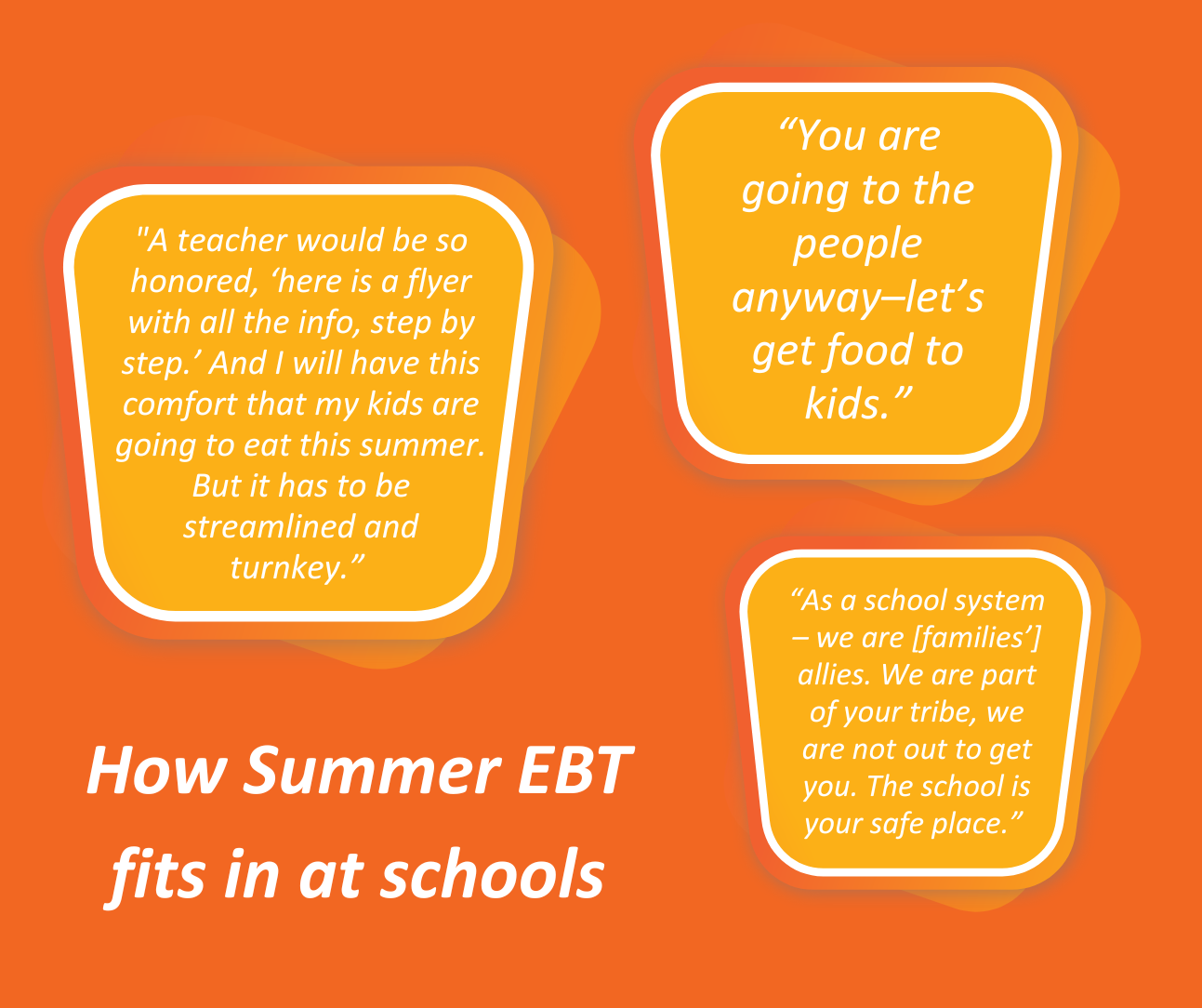
Many school staff and community-based partners are eager to share Summer EBT information, seeing it as their responsibility to connect families with these resources. They view it as a valuable way to directly support their students and families. Sharing Summer EBT communications does not need to be mandatory, and the effort remains valuable even if not every school actively promotes the program.
Our experience indicates that when we can get Summer EBT information to the right people within schools, the vast majority desire this information and are eager to share it with families. They are especially willing to do so when provided with plug-and-play resources they can use within existing channels.
Below, find our recommendations on particular school roles with whom we suggest sharing basic Summer EBT information, such as that included in the Summer EBT Guide for Partners. This resource is designed to include a high-level overview of the program, answers to the most frequently asked questions, and clear guidance on where to direct families for further information or when assistance is needed.
The following section focuses on strategies for engaging schools, but many of these strategies will be relevant for others within the community who are supporting families and connecting them with resources and support. We hope you will apply relevant strategies beyond the specific context of schools.
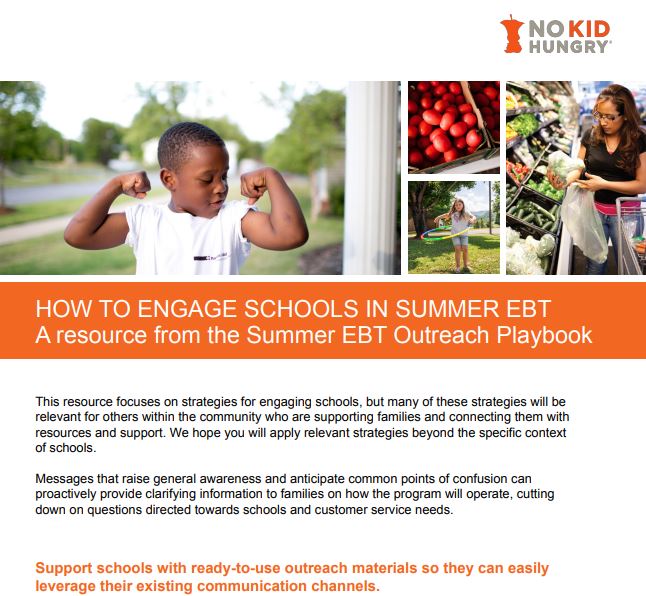
Download a PDF version of tips for Engaging Schools!
Messages that raise general awareness and anticipate common points of confusion can proactively provide clarifying information to families on how the program will operate, cutting down on questions directed towards schools and customer service needs.
Support schools with ready-to-use outreach materials so they can easily leverage their existing communication channels. Schools have established communication channels for sharing information with families (school newsletters, school social media, school websites, flyers sent home, monthly or seasonal in-person events, etc.). Make it simple for them to leverage their existing channels by providing finalized, state-specific outreach materials. Avoid asking or expecting schools to create their own materials, as this adds unnecessary burden and risks inconsistent or incorrect messaging and information. In states whose Summer EBT resources did not adhere to these principles, we heard from school staff who felt a need to create additional resources and explainers to help families access Summer EBT, adding to their workload and causing frustration among schools and families.
Our pilot and survey findings suggest that schools prefer and trust information that comes directly from agencies, and are more confident sharing it with families when it comes from official sources. Therefore, it is highly encouraged that agencies distribute materials directly, or through a trusted partner if necessary.
In our template resources you can find customizable resources in the formats most requested and desired by school staff. All of these should be finalized at the agency-level with state-specific information. These include:
A family-facing flyer (two-sided, with a simple program description and link to an eligibility checker on the front, and answers to families’ most common questions on the back). This can be distributed virtually, or printed (just the front, or both sides) for distribution during the school year or at summer meals.
Social media posts, with suggested timing to leverage the school calendar.
Language that can be used in a school newsletter, on a school website, or through a school messaging app (i.e. Remind, ClassDojo, ParentSquare, school WhatsApp channels).
Use messages via schools to raise general awareness and anticipate common points of confusion. This can proactively provide clarifying information to families on how the program will operate, cutting down on questions directed towards schools and customer service needs.
Ensure language accessibility. Ensure family-facing resources are available in the most relevant languages for your state, territory or tribe. We plan to offer templates of our NKH resources in English and Spanish, and translations into other languages may be needed in your communities. In general, outreach materials and tools should use plain language and be accessible using strategies described in the Communicating about Summer EBT section of this playbook.
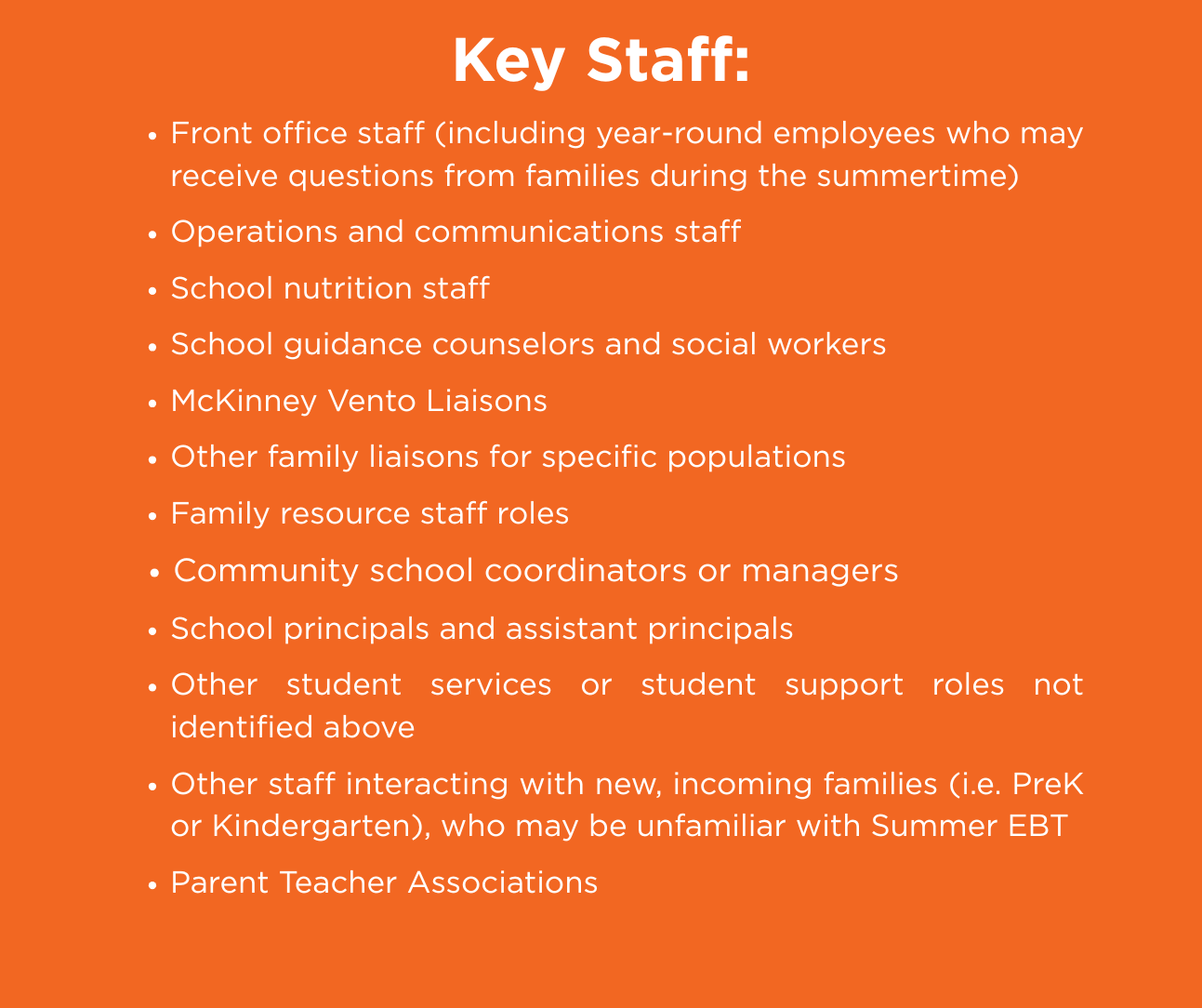
Identify the key school staff who need Summer EBT information and establish clear methods to distribute it broadly and efficiently. Based on feedback we received from school staff, it may be useful to ensure basic Summer EBT information is shared with people in a variety of roles. Exact titles vary, but consider this list!
Use multiple communication channels to distribute Summer EBT information to school staff in different roles, to maximize agency reach and impact. Start by engaging your main Summer EBT points of contact in schools, and asking them to share resources and training opportunities with other school staff and community members. Whenever possible, leverage formal communication channels within agency departments to efficiently reach specific roles that are connected to schools. If statewide networks or formal channels are limited, partner with state or regional professional associations, which are often eager to share state-specific resources with their members. By diversifying your outreach methods—such as email, newsletters, webinars, and association listservs—you not only ensure consistent messaging but also significantly expand your capacity to reach more family-facing staff quickly and effectively.

If statewide networks or formal channels are limited, partner with state or regional professional associations, which are often eager to share state-specific resources with their members. By diversifying your outreach methods—such as email, newsletters, webinars, and association listservs—you not only ensure consistent messaging but also significantly expand your capacity to reach more family-facing staff quickly and effectively.
Leverage the school calendar, capitalizing on school communication touchpoints that complement Summer EBT operation timelines. Summer EBT is cyclical, with different moments of the year requiring different actions on the part of families and schools. School-focused Summer EBT communications can align with the academic calendar to build awareness and ensure families take necessary steps when required. Based on feedback from states, districts and families, we encourage the timeline below, proposing strategic messages at specific moments (i.e. through recommended social media posts). For example, schools can promote general Summer EBT awareness in the spring as agencies prepare for benefit issuance; send program reminders before school lets out for summer; cross promote Summer EBT at Summer Food Service Program (SFSP) sites; and include the application deadline and benefit expiration reminders in back-to-school communications.
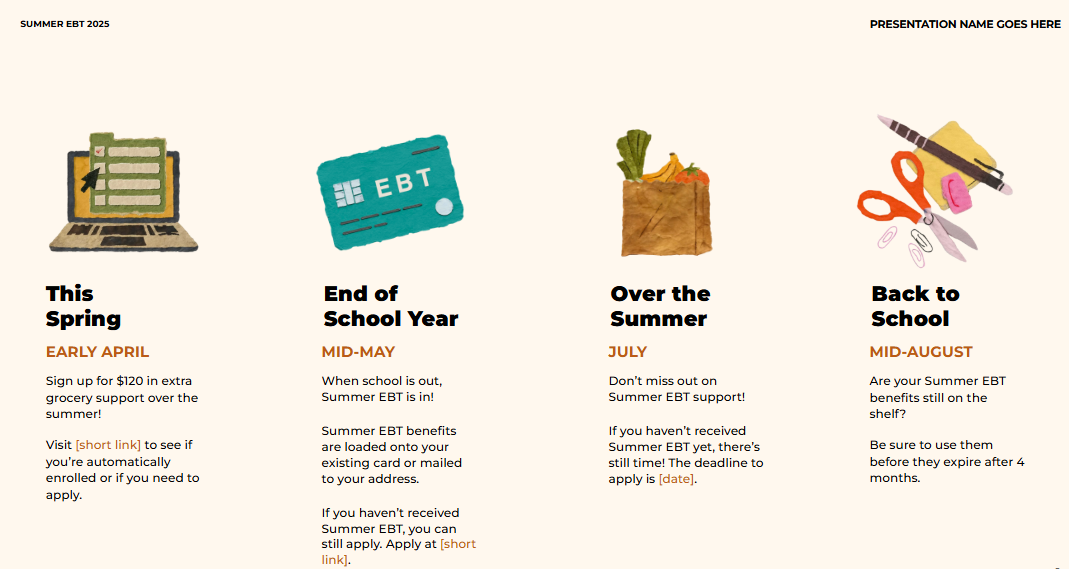
Social Media Timeline
Schools are uniquely positioned to directly reach “need-to-apply” families. Given program regulations and eligibility criteria, all students who are eligible to apply for Summer EBT must attend a school participating in the National School Lunch or School Breakfast Program. Clearly communicating with “need-to-apply” households is particularly critical for schools operating under Community Eligibility or other special provision programs. Because these schools provide free meals to all students, families do not complete meal applications, meaning children cannot be automatically enrolled (i.e. streamline certified) in Summer EBT through school meal certification. In this context, children that would typically receive free or reduced-price school meals by filling out a school meal application need to apply for Summer EBT in order to receive benefits. This nuance makes schools an essential messenger for this key Summer EBT message: while most eligible families are automatically enrolled, some must apply. Schools play a critical role in helping families determine whether they need to apply and can direct them to the Summer EBT application process.
School staff are likely to know which students and families may need to apply (eligible but not streamline-certified), and they can ensure these families receive Summer EBT program information through the communications channels these groups most trust and rely on.
See Comms in the Context of Free School Meals for All for key messages in CEP settings.
*Coming soon* Research from the Urban Institute will describe in greater detail how to identify this population that needs to apply for Summer EBT, and effective strategies for ensuring their access to the program.
Offer support for school staff, including a brief Summer EBT training and a Summer EBT Guide intended for the audience.
In early spring, consider offering a brief Summer EBT training opportunity open to any interested school staff, with a recording that can be shared. Make sure to include a discussion of anticipated FAQs in your state, based on incoming customer service calls and other persistent issues.
Offer a resource for school staff, such as a Summer EBT Guide, including basic program information, a suggested messaging timeline, answers to FAQs, and clear instructions on where to find more information.
See a template Summer EBT Guide for Partners
Consider offering the school staff resource in languages other than English. We received many requests for this resource in other languages in Summer 2025.
Take staff turnover into account. As awareness of and trust in the program grow, ensure key messengers like schools have a chance to understand program basics. Make updated resources available each year.
Consider offering a communication channel (such as an email address or phone number, or regular office hours) through which school staff can lift up repeated issues or questions directly to the agency. This communication channel can be included as a resource for schools, as appropriate.
Minimize questions directed towards schools.
Ensure the family-facing agency website for Summer EBT includes clear answers to frequently asked questions, including the most common issues raised via the customer service line, and that there are clear paths identified for additional information or assistance.

Ensure customer service hotlines, county SNAP offices and any other places likely to receive Summer EBT questions have clear, accurate, consistent information on the program, and that these entities are not directing families back to schools for more information about their individual Summer EBT eligibility status.
In this section, we highlight the importance of engaging a wide range of community partners to strengthen Summer EBT outreach and provide guidance on building strategic collaborations. These recommendations draw on lessons learned from our work with national, state and local partners during the 2024 and 2025 program operations.
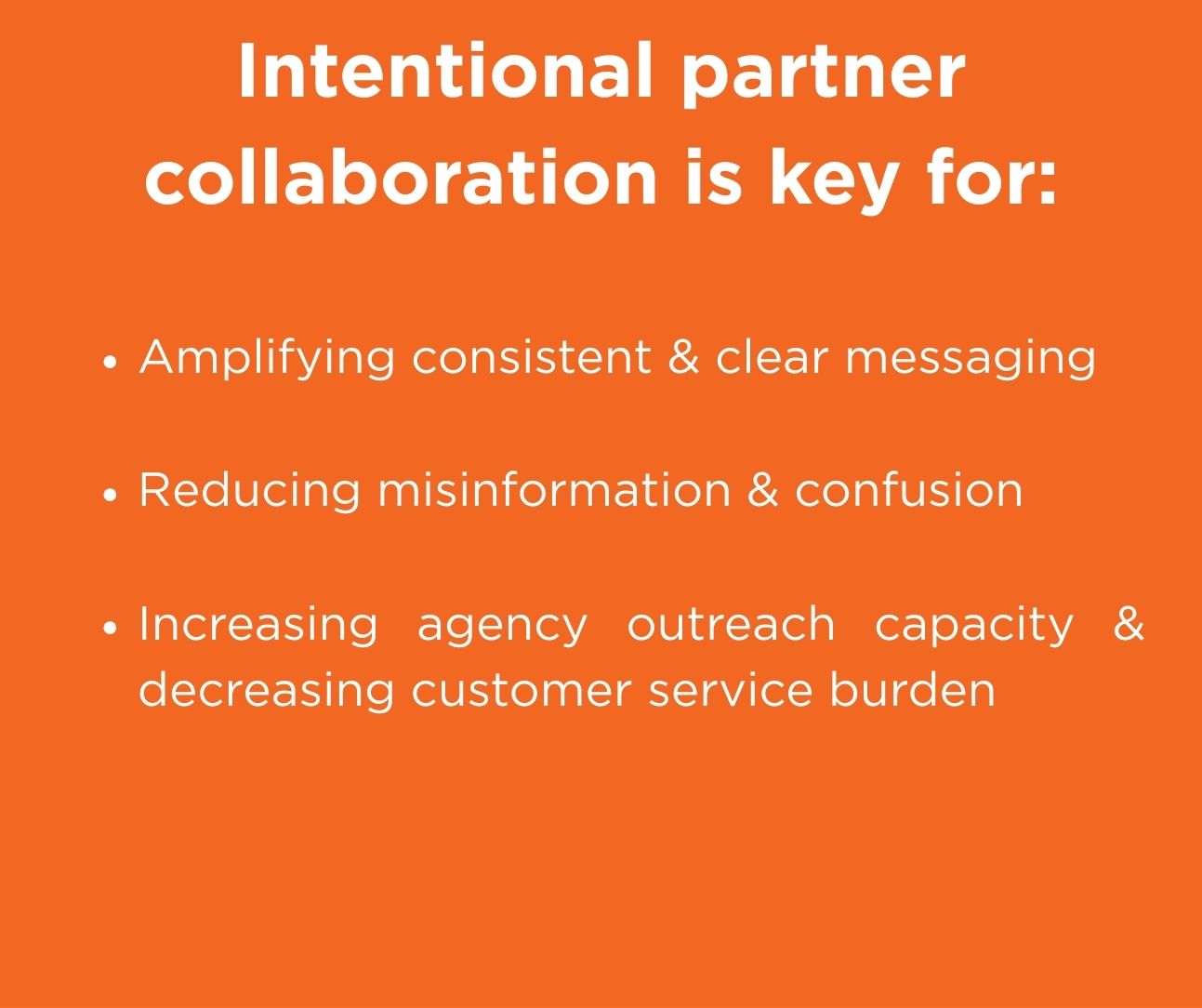
Strategic, trusted partners are essential for effective Summer EBT outreach. Families need clear, accurate information about this new program, and many community partners are uniquely positioned to deliver it. By leveraging tailored outreach strategies through trusted messengers, we can break down barriers, ease the customer service burden on agencies, and ensure more families can access benefits. Strategic collaboration isn’t just helpful–it can enhance your outreach impact.
Connect with organizations and individuals families already trust and engage with. These messengers play a vital role in amplifying your message and building awareness in the Summer EBT program.
Community organizations and schools eager to support Summer EBT outreach say timely information and resources are critical to their success. The sooner administering agencies engage, train, and equip trusted partners with resources, the more time for planning and strategizing. External partners understand this is a new program and appreciate the challenges of finalizing operation details well ahead of time. That’s why consistent, open communication is essential. Keeping partners informed with the latest information can help mitigate misinformation within their networks and ensures they’re ready to act when it’s time to share information with families.

To strengthen these partnerships, provide opportunities for training , open communication, feedback, and ongoing collaboration in addition to ready-to-use outreach materials.
Check out the Communicating About Summer EBT section of the playbook for template resources and key messages to equip partners to support your Summer EBT outreach!
Building sustainable outreach plans from year to year for Summer EBT is essential. Administering agencies have varying degrees and often limited resources that they can put towards outreach and communications for Summer EBT. External partners help sustain and grow connections for Summer EBT outreach by equipping their own networks with the knowledge and tools to effectively promote the program to families. When administering agencies intentionally engage a diverse range of external partners with clear, accurate information, they expand their outreach capacity and reduce customer service burden. Over time, these partnerships can evolve into strong networks, ultimately integrating Summer EBT outreach into their ongoing family engagement. As conveners and the primary source of truth, administering agencies ensure consistency and accuracy in messaging, which is critical to building and sustaining understanding of the Summer EBT program with the public.
Note to user: this section of the playbook focuses on external partners more generally. For tips for working with schools, see the Partnering with Schools section of the playbook.
Identify gaps in participation and connect with partners who can help close them. Use available data, such as redemption or application data, to spot communities or groups of children who aren’t enrolled in Summer EBT or aren’t utilizing benefits. These insights can guide your outreach strategy and help you identify partners who can reach populations that might otherwise be missed.
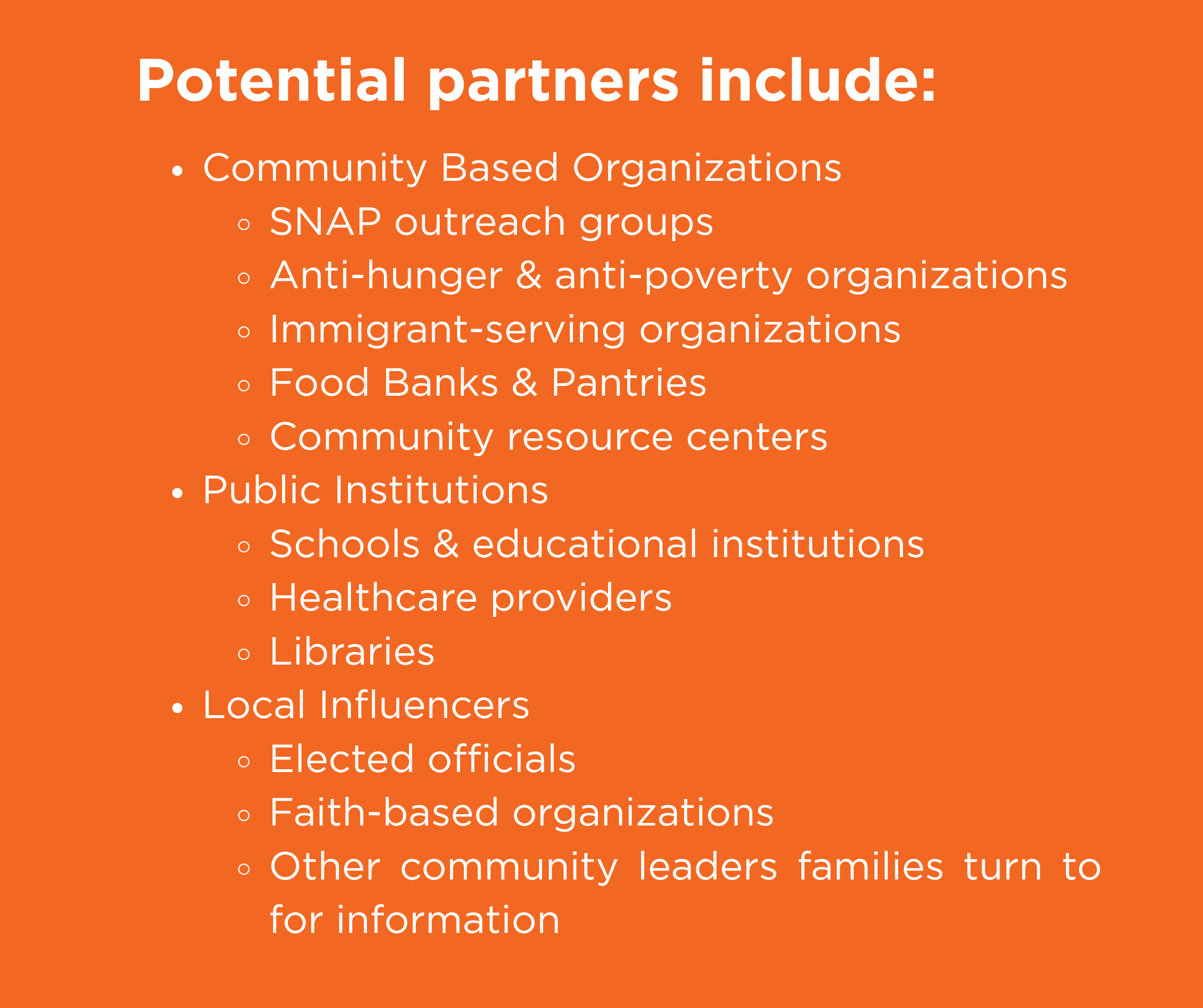
Who else in local communities do families go to for information? External partners can help bridge critical gaps—such as delivering targeted outreach to families and gathering firsthand insights on the challenges they face in accessing Summer EBT benefits. These messengers can amplify your message and build confidence in the program.
Leverage Partners’ Direct-to-Family Communication Channels
Leveraging partners for social media campaigns, or other established communication channels, can significantly amplify your outreach efforts. The key is identifying partners that have established, trusted relationships with families you are trying to reach and strong engagement on their own platforms, making them powerful messengers for trusted Summer EBT information. By tapping into their networks, you can extend your reach far beyond your agency’s followers and connect with audiences who may not otherwise see your messages. Partners can share content organically (unpaid) or run paid campaigns, ensuring accurate information is delivered through channels families already trust. This approach not only increases visibility but also builds credibility and reduces burden on your agency’s resources.
Share Our Strength supported national, state, regional and local targeted social media campaigns for 2025 Summer EBT operations. We found that partners were highly effective in adding a personal touch by sharing posts in their own voice and tailoring messages to reflect their network, along with practical information about how to access and use Summer EBT benefits. When families commented with questions—such as whether they need to apply or when they will receive benefits—partners were able to respond directly, providing clear answers and links to official agency resources. This real-time engagement not only builds trust but prompts families to take action to be able to use their benefits.
Targeted Outreach for Specific Barriers to Participation
- Some children will always face unique challenges to participation and trusted partners can help reach these families. For example, households without a stable mailing address may struggle to receive mail reliably. Tailored strategies—such as email or text message communication channels or in-person support at homeless shelters—can help ensure these families don’t miss out.
Coming soon! In partnership with APHSA, we will provide practical solutions that agencies have used to reach more children with benefits.
See the Agency Communications section of the playbook for more tips and strategies to reach more kids!
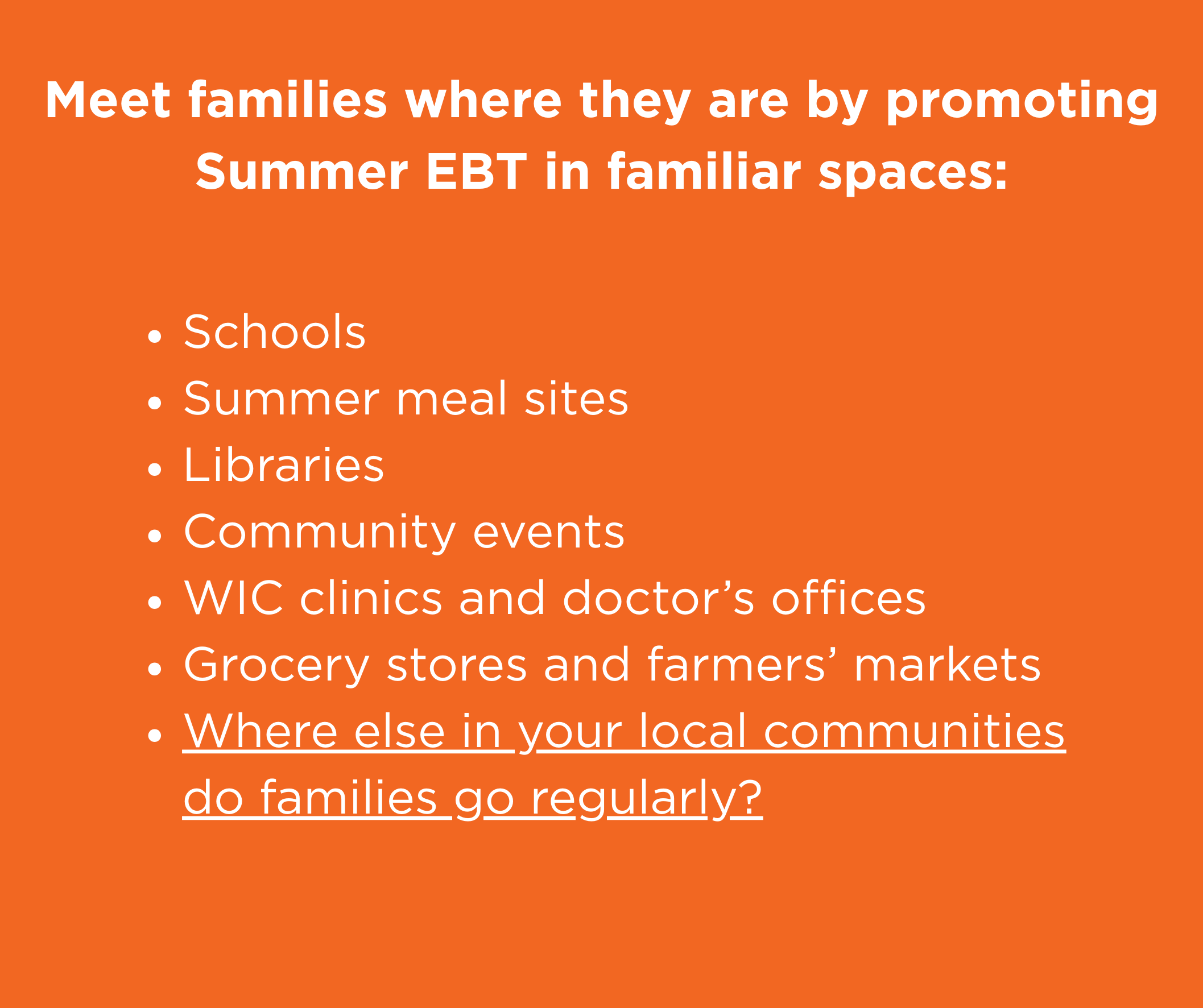
Cross-promote Summer EBT in places families already go! These touchpoints make it easier for families to learn about Summer EBT benefits in spaces they already go to.
Coming soon! Real-world examples from national, state, and local partnerships that have driven meaningful impact.
One of the biggest communication challenges in implementing Summer EBT is helping families understand who needs to apply and why. This challenge is amplified when communicating to households that have children who attend schools that offer free meals to all students through special provision programs like Community Eligibility Provision (CEP) or state-funded universal free school meals initiatives.
Summer EBT eligibility and enrollment can be confusing for families because the connection between receiving free school meals and Summer EBT benefits is not always straightforward. Confusion arises because one way children qualify for Summer EBT is by being approved to receive free school meals – either through direct certification or by submitting a National School Lunch Program (NSLP) application at their school. Children who meet these criteria are automatically enrolled in Summer EBT and do not need to submit a separate Summer EBT application.
Schools that offer free meals to all students through programs like CEP do not collect NSLP applications.
This means families who would normally submit an NSLP application to establish eligibility for free and reduced-price school meals cannot do so in these schools. As a result, these households often need to apply for Summer EBT, but they may not realize it because of the assumption that because their child receives free meals at school, they automatically qualify for Summer EBT.
Understanding Eligibility: Families often assume that because their child receives free meals at school, they automatically qualify for Summer EBT. This is not always true.
- Knowing Whether to Apply: Even if a child is eligible, parents may not know whether enrollment is automatic or requires an application. They may assume, because other children receive the benefit automatically, that they are not eligible.
- Mixed CEP & non-CEP School Situations: Households with children in both CEP and non-CEP schools face added complexity, as eligibility and enrollment process may differ for children in the same household. Families may be confused when they receive a benefit automatically for one child but not another
Goal: Emphasize that receiving free school meals does not automatically qualify a household for Summer EBT. Eligibility and enrollment are based on participation in other state programs or by completing a Summer EBT application.
Focus on Clarifying Eligibility & Enrollment Pathways for Summer EBT
Focus eligibility and enrollment on child participation in an income-based state program like SNAP, TANF or Medicaid, and if not enrolled in one of these programs, direct families to apply for Summer EBT via an application.
Receiving free schools meals through CEP or universal free meal programs does NOT guarantee Summer EBT eligibility or automatic enrollment. It's important to clarify for families with children in these schools: if they believe they might qualify and haven't received benefits, they should apply for Summer EBT.
It is important to remember that for some families eligible for Summer EBT via application, this may be their first interaction with a federal nutrition program. In CEP or universal free meal settings, consider strategies to raise awareness of Summer EBT and the potential need to apply among families new to the school system, especially those in PreK and Kindergarten programs.
Are you a Summer EBT Administrator? We want to hear from you!
Are you a Summer EBT Administrator? We want to hear from you!